Lists and Arrays
Learn all about Lists and Arrays in this comprehensive tutorial.
- •In Python, lists are the built-in data structure that serves as a dynamic array.
- •A list is a built-in data structure in Python, used to store multiple elements.
- •Lists are created using square brackets []:
- •Python lists come with several built-in algorithms (called methods), to perform common operations like appending, sorting, and more.
- •Sometimes we want to perform actions that are not built into Python.
- •When exploring algorithms, we often look at how much time an algorithm takes to run relative to the size of the data set.
Introduction
In Python, lists are the built-in data structure that serves as a dynamic array.
Lists are ordered, mutable, and can contain elements of different types.
Lists
A list is a built-in data structure in Python, used to store multiple elements.
Lists are used by many algorithms.
Creating Lists
Lists are created using square brackets []:
List Methods
Python lists come with several built-in algorithms (called methods), to perform common operations like appending, sorting, and more.
Create Algorithms
Sometimes we want to perform actions that are not built into Python.
Then we can create our own algorithms.
For example, an algorithm can be used to find the lowest value in a list, like in the example below:
The algorithm above is very simple, and fast enough for small data sets, but if the data is big enough, any algorithm will take time to run.
This is where optimization comes in.
Optimization is an important part of algorithm development, and of course, an important part of DSA programming.
Time Complexity
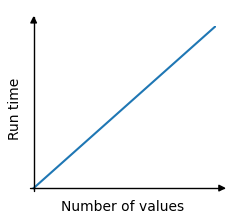
When exploring algorithms, we often look at how much time an algorithm takes to run relative to the size of the data set.
In the example above, the time the algorithm needs to run is proportional, or linear, to the size of the data set. This is because the algorithm must visit every array element one time to find the lowest value. The loop must run 5 times since there are 5 values in the array. And if the array had 1000 values, the loop would have to run 1000 times.
Try the simulation below to see this relationship between the number of compare operations needed to find the lowest value, and the size of the array.
See this page for a more thorough explanation of what time complexity is.
Each algorithm in this tutorial will be presented together with its time complexity.
Module quiz
Test your knowledge on this module