Linear Search
Learn all about Linear Search in this comprehensive tutorial.
- •Linear search (or sequential search) is the simplest search algorithm.
- •In Python, the fastest way check if a value exists in a list is to use the in operator.
- •If Linear Search runs and finds the target value as the first array value in an array with \(n\) values, only one compare is needed.
Linear Search
Linear search (or sequential search) is the simplest search algorithm. It checks each element one by one.
Run the simulation above to see how the Linear Search algorithm works.
This algorithm is very simple and easy to understand and implement.
Implement Linear Search in Python
In Python, the fastest way check if a value exists in a list is to use the in operator.
But if you need to find the index of a value, you will need to implement a linear search:
To implement the Linear Search algorithm we need:
- An array with values to search through.
- A target value to search for.
- A loop that goes through the array from start to end.
- An if-statement that compares the current value with the target value, and returns the current index if the target value is found.
- After the loop, return -1, because at this point we know the target value has not been found.
Linear Search Time Complexity
If Linear Search runs and finds the target value as the first array value in an array with \(n\) values, only one compare is needed.
But if Linear Search runs through the whole array of \(n\) values, without finding the target value, \(n\) compares are needed.
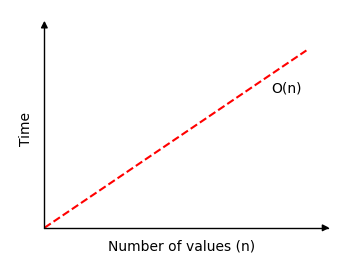
This means that time complexity for Linear Search is: \( O(n) \)
If we draw how much time Linear Search needs to find a value in an array of \(n\) values, we get this graph:
Module quiz
Test your knowledge on this module