Add Styles to the Project
Learn all about Add Styles to the Project in this comprehensive tutorial.
- •If you have followed the steps in the entire Django tutorial, you will have a my_tennis_club project on your computer, with 5 members:
- •Now you have a css file, the next step will be to include this file in the master template:
- •Make sure your settings.
- •Every time you make a change in a static file, you must run the collectstatic command to make the changes take effect:
- •In the example above we showed you how to include a stylesheet to your project.
- •You also have to make some changes to the templates:
- •Since we did some changes in the static mystyles.
The Project - My Tennis Club
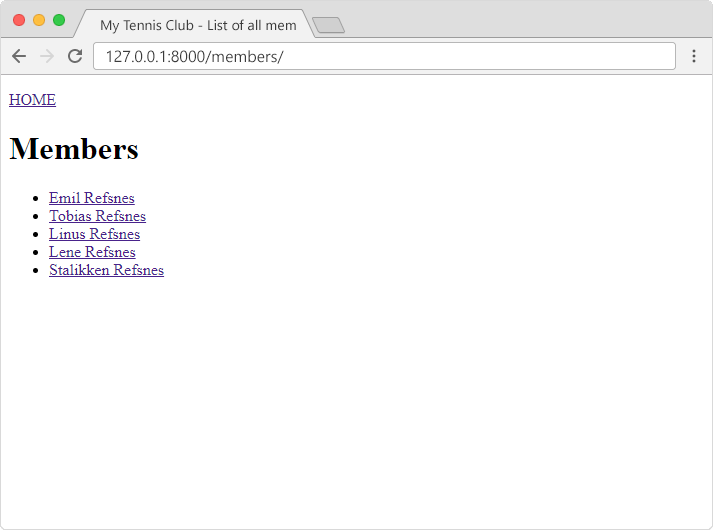
If you have followed the steps in the entire Django tutorial, you will have a my_tennis_club project on your computer, with 5 members:
Run Example
We want to add a stylesheet to this project, and put it in the mystaticfiles folder:
The name of the CSS file is your choice, we call it mystyles.css in this project.
Open the CSS file and insert the following:
Modify the Master Template
Now you have a css file, the next step will be to include this file in the master template:
Open the master template file and add the following:
Check Settings
Make sure your settings.py file contains a STATICFILES_DIRS list with a reference to the mystaticfiles folder on the root directory, and that you have specified a STATICFILES_ROOT folder:
Collect Static Files
Every time you make a change in a static file, you must run the collectstatic command to make the changes take effect:
If you have executed the command earlier in the project, Django will prompt you with a question:
Type 'yes'. This will update any changes done in the static files, and give you this result:
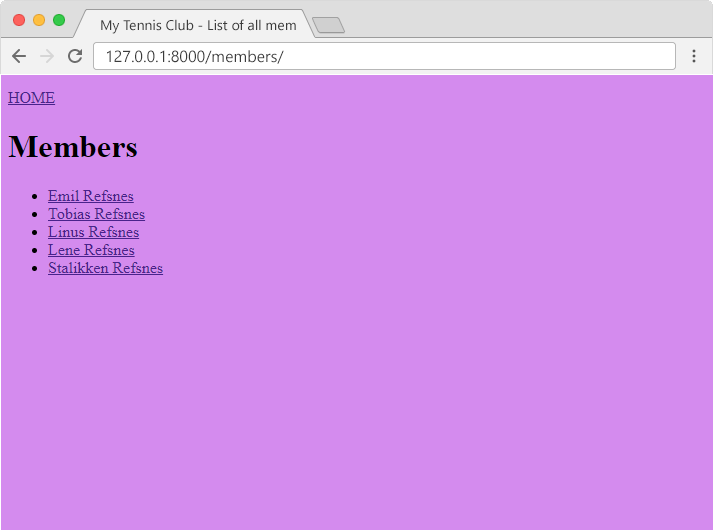
Now, if you run the project:
It will look like this:
Run Example
If you have followed all the steps on you own computer, you can see the result in your own browser:
In the browser window, type 127.0.0.1:8000/members/ in the address bar.
Spice up the Style!
In the example above we showed you how to include a stylesheet to your project.
We ended up with a purple web page, but CSS can do more than just change the background color.
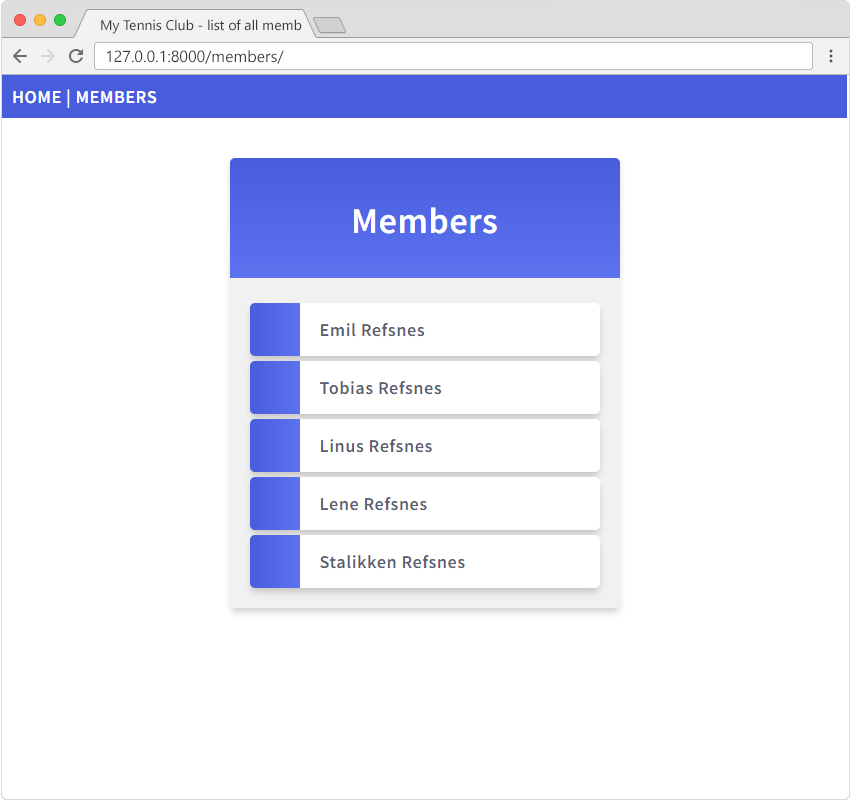
We want to do more with the styles, and end up with a result like this:
Run Example
First, replace the content of the mystyles.css file with this:
Modify Templates
You also have to make some changes to the templates:
We want all pages to have the same top navigation, therefor we insert the top navigation into master.html:
In all_members.html we want to make some changes in the HTML code.
The members are put in a div element, and the links become list items with onclick attributes.
We also want to remove the navigation, because that is now a part of the master template.
In details.html we will put the member details in a div element, and remove the link back to members, because that is now a part of the navigation in the master template.
In the main.html template, we will put some of the HTML code into a div element:
Collect Static Files
Since we did some changes in the static mystyles.css file, we have to run the collectstatic command to make the changes take effect:
Now, if you run the project:
You can see what the result should look like:
Run Example
Or, if you have followed all the steps on you own computer, you can see the result in your own browser:
In the browser window, type 127.0.0.1:8000/members/ in the address bar.
Module quiz
Test your knowledge on this module